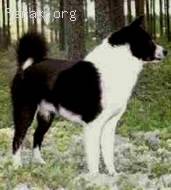
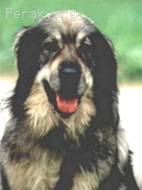
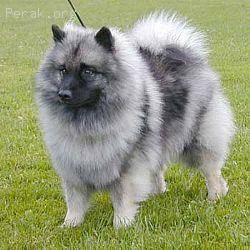
狗的种类 (应该有五百多种)

Group
Fédération Cynologique Internationale, American Canine Registry, American Canine Association, Inc.
Native Country
Iceland-England
Other Names
Icelandic Sheepdog, Iceland Sheepdog, Islandsk Farehond, Friaar Dog, Islenkur Fjárhundur, Icelandic Dog
Breed Description

Head: Light and fairly broad. Distinct stop. Fairly short muzzle. Tight lips.
Ears: Broad at the base. Triangular with pointed tips. Carried very erect.
Eyes: Small, round. Dark color.
Body: Strong, fairly short. Not heavy. Strong neck. Broad, deep chest. Belly is well tucked up.
Tail: Moderate length. Thick. Carried curled over the back.
Hair: Hard, moderately long. Longer on the neck, thighs, and under the tail. Short on the head and legs. Lies flat on the body.
Coat: White with fawn, golden, or light fawn markings with black tips.
Size: Dog: 42 to 48 cm (16.5-18.9 in).Bitch: 38 to 44 cm ( 15-17 in).
Weight: 10 to 15 kg (22-33 lb).

History

This breed is probably descended from the Norwegian Buhund which was crossed with local Icelandic breeds. The Iceland Dog was used to guard sheep and horses. In the nineteenth century, the breed was almost wiped out by distemper, but was saved by breeders in Iceland and England. The breed is rare in France.

Behavior

This sturdy, hardy dog has a strong personality. He is affectionate and very friendly with people. This alert dog likes to bark, making him a good guard dog. Firm training is required.

Advice

This breed is accustomed to living in the great outdoors, therefore keeping him as a house dog is not recommended. The Iceland Dog needs room to run. Regular brushing is required.

Function

Herder, guard dog, pet.
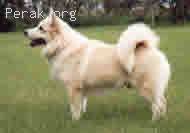
Iceland_Hound.jpg

Group
Sporting Group - American Kennel Club, Continental Kennel Club, Fédération Cynologique Internationale, United Kennel Club, Kennel Club of Great Britain, Canadian Kennel Club, Australian National Kennel Club, National Kennel Club, New Zealand Kennel Club, Canadian Canine Registry, American Pet Registry Inc., American Canine Registry
Native Country
Ireland
Other Names
Irish Red Setter
Breed Description

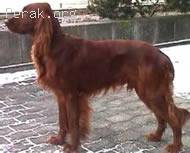
Head: Long, cleanly cut, without heaviness. Oval skull. Pronounced occipital peak. Pronounced stop. Muzzle fairly angular. Flews not pendulous. Nose mahogany, brown, or black. Head slightly broader in the red and white variety.
Ears: Set on low, medium-sized, thin, hanging with a fold flat against the head. Set on at eye level in the red and white variety.
Eyes: Not too big, dark (hazel or brown).
Body: Well-proportioned. Neck very muscular, not too thick, without dewlap. Chest narrow when viewed from the front, as deep as possible. Rounded ribs. Muscular, slightly arched loin.
Tail: Set on fairly low, medium in length, thick at the base, tapering to a thin point. Carried level with the topline or lower. Beautiful feathering.
Hair: Short on the head and fronts of the legs. Elsewhere, hair is medium in length, flat, neither wavy nor curly. Feathering long and silky at the tops of the ears, long and fine on the backs of the legs. Beautiful feathering on the abdomen.
Coat: Mahogany setter: golden mahogany, never smoky. White markings on the chest, throat, or toes, small flashings on the forehead, or a narrow flare on the nosebridge or head are tolerated.
Size: Red and white: dog: 62 to 66 cm (24.5-26 in); bitch: 57 to 61 cm (22.5-24 in). Red: dog: 57 to 70 cm (22.5-27.5 in); bitch: 54 to 67 cm (21-26.5 in).
Weight: 20 to 25 kg (44-55 lb).

History

The Irish setter comes in two varieties: solid red, and red and white. By about the nineteenth century, the solid red variety had virtually eclipsed the red and white variety, which became so rare that some considered it extinct. In the 1920s, an attempt was made to revive it, sparking renewed interest. The first standard for the Irish Setter was published in 1885. Founded in 1906, the Irish Setter Club (Red Club) oversees the breed in France. The beautiful Irish Setter is so popular as a pet that people often forget his skill as a hunter.

Behavior

The Irish Setter is bursting with energy, spirited, and independent. He has a highly developed sense of smell and works rapidly, but his search range is smaller than that of the English Pointer. He is flexible and points firmly. He specializes in woodcock and partridge. Very affectionate, Irish Setters make wonderful pets. They need firm but gentle training.

Advice

To live in the city, he needs lots of exercise for his physical and emotional well-being. He requires daily brushing and regular attention to the ears.

Function

Hunting dog, companion dog.
Irish_Setter.jpg

Group
Terrier Group - American Kennel Club, Continental Kennel Club, Fédération Cynologique Internationale, United Kennel Club, Kennel Club of Great Britain, Canadian Kennel Club, Australian National Kennel Club, National Kennel Club, New Zealand Kennel Club, Club Español de Terriers (Spanish Terrier Club), American Pet Registry Inc., American Canine Registry
Native Country
Ireland
Other Names
Irish Red Terrier
Breed Description

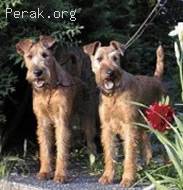
Head: Long. Flat, fairly narrow skull. Stop hardly visible. Strong jaws. Close, well-fitting lips.
Ears: Small, v-shaped, falling forward along the cheeks.
Eyes: Small. Dark color.
Body: Neither too long nor too short. No dewlap on neck. Deep, muscular chest. Muscular, very slightly arched loin. Strong, straight back
Tail: Set on fairly high. Carried gaily but not over the back or curled. Typically docked to three-quarters its normal length.
Hair: Dense, very compact, wiry, with broken appearance but still lying close to the body. Must not be curly or form tufts. Hair on the face is short (0.6 cm). The only long hair that is acceptable is a slight beard.
Coat: Whole-colored. Preferred colors are bright red, red wheaten, and golden red. White markings on the forechest and feet are permissible.
Size: Approx. 45 cm (18 in).
Weight: Dog: 12.2 kg (27 lb).Bitch: 11.4 kg (25 lb).

History

This terrier is thought to have existed in Ireland for centuries, but its origins have been obscured by time. The Irish Terrier could be descended from the old breed of wire-haired black and tan terrier and a larger variety of the Wheaten Terrier, which is said to have lived in the county of Cork. This breed’s modern type was fixed in 1875. Before type was fixed, the breed’s coloring could be red, black and tan, or even brindle. An Irish Terrier club was formed in 1879, and the first standard for the breed was established in 1880. During World War I, the Irish Terrier served side-by-side with English soldiers.

Behavior

This robust, fast dog has great endurance and plenty of spirit. He is independent, combative, and stubborn. The Irish Terrier is affectionate, cheerful, and devoted to his owner, making him a good pet. This hunting dog, at home on land and in the water, is used to hunt hare, vermin, and otter. As a guard dog he can be ferocious if attacked and will fight to the death. The Irish Terrier is aggressive with other dogs. Firm but gentle training is required.

Advice

This dog can adapt to life as a house dog, but he requires considerable space and exercise. Brushing once or twice per week is required. This breed should be groomed two times per year.

Function

Hunting dog (shooting and with hounds), guard dog, pet.
Irish_Terrier.jpg

Group
Sporting Group -
Native Country
Ireland
Other Names
IWS, Whiptail
Breed Description

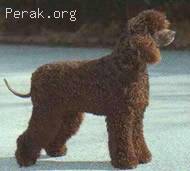
Head: Large but long. Domed skull covered with long curls forming a topknot. Gradual stop. Long, strong, angular muzzle. Dark liver nose.
Ears: Set on low, very long, hanging against the cheeks, covered with long curls.
Eyes: Medium to dark brown.
Body: Compact. Sturdy, fairly long neck. Broad chest. Ribs set well back. Short, broad back. Deep, broad loin.
Tail: Set on low, short, straight, thick at the base and tapering toward the tip. Carried straight, below the topline. A well-defined band extending 8 to 10 cm from the base must be covered with tight curls. The rest of the tail is hairless or covered with fine, straight hair.
Hair: Thick, tight, crisp curls. Oily hair. Feathering on the legs.
Coat: Dark liver with a bluish or velvety cast specific to the breed and sometimes called “puce”.
Size: Dog: 53 to 58 cm (21-22.8 in). Bitch: 51 to 56 cm (20-22 in).
Weight: 22 to 26 kg (28.5-57.5 lb).

History

The Irish Water Spaniel, the largest of the spaniels, was developed in the nineteenth century from the Poodle, the Irish Setter, and perhaps the Barbet. Some believe he is a close cousin to the Portuguese Water Dog. The Irish Water Spaniel was first shown in 1862 in Birmingham. The first club was founded in 1890. After a fruitful period between the two World Wars when he was exported to France, the United States, and Canada, he is now rare and in danger of extinction.

Behavior

Dynamic, active, enthusiastic, and tenacious, the Irish Water Spaniel has great endurance and a very discerning nose. He specializes in wild birds (including duck). He is a good flusher and well-adapted to working in the water. His search is hard-driving and quick, and he is silent on the trail. Adorable and courageous, according to some, he is often difficult. He needs firm training.

Advice

He needs wide open spaces and lots of exercise, as well as combing twice weekly and regular checking of the ears.He needs wide open spaces and lots of exercise, as well as combing twice weekly and regular checking of the ears.

Function

Hunting dog.
Irish_Water_Spaniel.jpg

Group
Hound Group - American Kennel Club, Continental Kennel Club, Fédération Cynologique Internationale, United Kennel Club, Kennel Club of Great Britain, Canadian Kennel Club, Australian National Kennel Club, National Kennel Club, Irish Wolfhound Club of America, New Zealand Kennel Club, American Pet Registry Inc., American Canine Registry
Native Country
Ireland
Other Names
Wolfhound
Breed Description

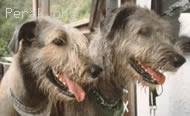
Head: Long. Skull not too wide. Long, moderately pointed muzzle.
Ears: Small, carried like those of the Greyhound.
Eyes: Dark.
Body: Powerful, elongated. Neck fairly long, very strong and muscular, well-arched, without dewlap. Wide, very deep chest. Arched loin. Pronounced tuck-up. Fairly long back.
Tail: Long, slightly curved, moderately thick and well-furnished with hair.
Hair: Harsh and rough on the body, legs and head. Especially hard and long above the eyes and below the jaw.
Coat: Grey, brindle, chestnut, black, pure white or any other color appearing in the Deerhound.
Size: Dog: at least 79 cm (31 in) (preferably 81 to 86 cm) (32-34 in).Bitch: at least 71 cm (28 in).
Weight: Dog: at least 54 kg (119 lb).Bitch: at least 40,5 kg (89,5).

History

The Irish Wolfhound, the world’s largest sighthound, may be descended from dogs brought to Ireland by the Celts or from an old breed indigenous to Ireland. Some believe it is the product of crossing Irish sheepdogs with Arabian Greyhounds. Others believe the Deerhound was used in creating the breed, developed to hunt and kill wolf. The Irish Wolfhound nearly went extinct around 1800, at the same time as the wolf. In 1860, Captain G. Graham decided to revive the breed by crossing the last specimens with the Deerhound and perhaps the Great Dane, the Borzoi and other breeds. The Irish Wolfhound was recognized by the Kennel Club in 1897.

Behavior

This very bold dog with incredible stamina and strength may be gentle when petted but can be ferocious when provoked. He hunts wolf and wild boar and also makes an effective, dissuasive watchdog. He should not be trained as a defence and attack dog, since he could be very dangerous. Calm and gentle with children, he is very attached to his owner. Firm training is necessary to keep him under control.

Advice

He should not live in the city. He needs to run often in wide open spaces. He must be brushed weekly.

Function

Hunting dog, companion dog.
Irish_Wolfhound.jpg

Group
Fédération Cynologique Internationale, National Kennel Club, Continental Kennel Club, American Pet Registry Inc., American Canine Registry, American Canine Association
Native Country
Former Yugoslavia
Other Names
Istarski Ostrodlaki Gonic, Istarski Kratkolaki Gonic, Wirehaired Istrian Hound, Smoothhaired Istrian Hound, Istrian Pointer
Breed Description

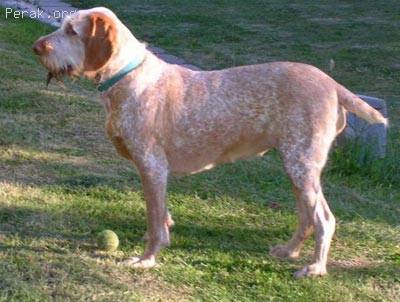
Head: Long, not very lightweight. Slightly domed skull. Fairly broad forehead. Stop not very pronounced. Strong, rectangular muzzle. Well-joined lips. Visible mucosas are dark.
Ears: Long, hanging against the cheeks.
Eyes: Large, dark. Eyebrows very bushy and thick in the wirehaired variety.
Body: Robust, slightly longer than it is tall. Neck has no dewlap. Broad chest. Rounded ribs. Slight tuck-up. Broad, slightly sloping croup. Straight, broad back.
Tail: Thick at the base, tapering toward the tip. Carried low, curved slightly upward.
Hair: Wirehaired: 5 to 10 cm long, standing on end. Thick, short undercoat.- Smoothhaired: fine, dense, and glossy.
Coat: White. Ears usually orangish or covered with orangish flecks. Orange flashings on the forehead. Orangish spots and flecks may also appear on the body.
Size: 44 to 58 cm. (17-23 in).
Weight: 18 to 20 kg. (40-44)

History

This very ancient breed has always been prized in Istria. The breed’s mysterious origins probably match those of Italian hounds. The two varieties of Istrian Hound are the Wirehaired Istrian Hound (Istarski Ostrodlaki Gonic) and the more popular Smoothhaired Istrian Hound (Istarski Kratkolaki Gonic), also known as the Istrian Pointer.

Behavior

The Istrian Hound is calm, has a powerful voice, excels on hare and fox, and is a very good bloodhound. He is affectionate and makes a good companion.

Advice

He needs space and lots of exercise and requires regular brushing.

Function

Hunting dog.
Istrian_Hound.gif

Group
Toy Group - American Kennel Club, Continental Kennel Club, Fédération Cynologique Internationale, United Kennel Club, Kennel Club of Great Britain, Canadian Kennel Club, Australian National Kennel Club, National Kennel Club, New Zealand Kennel Club, American Pet Registry Inc., American Canine Registry
Native Country
Italy
Other Names
Piccolo Levriero Italiano, IG
Breed Description

Head: Long, narrow. Flat skull. Stop not very pronounced. Pointed muzzle. Cleanly cut cheeks. Thin lips.
Ears: Set on high, small. Folded back on themselves and carried against the upper neck.
Eyes: Large, dark. Edge of eyelids pigmented.
Body: Square build. Neck shaped like a short cone, without dewlap. Fairly pronounced withers. Chest deep, well let-down, narrow.
Tail: Set on low, thin even at the base, tapering gradually toward the tip. First half carried low and straight; remainder curving.
Hair: Close-lying and fine on entire body.
Coat: Solid or any shade of black, grey, slate grey, slate, or yellow. White is tolerated only on the chest and feet.
Size: 32 to 38 cm.
Weight: Up to 5 kg.

History

This very ancient breed—possibly a mutated Egyptian Greyhound—was brought to Italy via Greece as early as the fifth century B.C., as evidenced by numerous representations on vases and mixing bowls. The Italian Greyhound was very common in the Roman Empire and throughout the Middle Ages but was most popular with the nobility of Renaissance times. This dog was commonly painted by the grand masters of Italy and abroad. The Italian Greyhound charmed the elite of this period, from King François I to Frederick the Great. Then interest in the dog waned, due to a decline in the breed caused by miniaturization. After World War II, the breed was revived, and its earlier traits were restored. A standard was established in 1968.

Behavior

This tiny Greyhound or miniature Arabian Greyhound often quivers with excitement. Despite his dainty and fragile appearance, he is lively, energetic, hardy, and agile. He likes to hunt small game (including rabbit and hare). Affectionate, intelligent, very loving, merry, and playful, he is a charming pet. He is quiet, reserved, and distant toward strangers. He needs gentle but firm training.

Advice

He can adapt to city life but needs exercise. He does not like being left alone and cannot tolerate cold weather and rain. He requires regular brushing.

Function

Pet.
Italian_Greyhound.jpg

Group
Fédération Cynologique Internationale, National Kennel Club, Continental Kennel Club, American Pet Registry Inc., American Canine Registry, American Canine Association
Native Country
Italy
Other Names
Segugio Italiano
Breed Description

Head: Long. Slightly domed skull. Stop not very pronounced. Large nose. Long, domed nosebridge.
Ears: Triangular, flat, pendulous, pointed at the tips.
Eyes: Large, dark ocher-colored.
Body: Can be inscribed inside a square. Very well-knit neck without dewlap. Moderately wide chest. Well-muscled loin. No tuck-up. Straight, muscular back. Level, well-muscled croup.
Tail: Set on high, hanging in saber fashion. Carried no higher than the back in action.
Hair: Medium in length (under 5 cm), harsh except for on the head, legs, and tail. A shorthaired variety with smooth hair also exists.
Coat: Solid fawn, ranging from dark smoky reddish-fawn to light fawn, and black and tan. Fawn may be accompanied by white markings on the muzzle, skull, neck, lower legs, and tip of the tail, and white flashings on the chest.
Size: Dog: 52 to 60 cm. (20.5-23.5 in).Bitch: 50 to 58 cm. (20-23 in).
Weight: Dog: 20 to 28 kg. (44-62 lb).Bitch: 18 to 26 kg. (40-57.5 lb).

History

The Italian Hound’s origins are quite distant. The descendant of Egyptian scenthounds, he is believed to have been imported to Greece and then Italy, where he might have been crossed with the Roman Molossus. Images of this scenthound can be found in ancient statuary, as well as in Renaissance paintings. By the late nineteenth century, the breed had branched into several varieties, including the Lomellina Hound and Alpine Hound, which were used to develop today’s breed. An Italian Hound won the first European Cup in 1993 in France.

Behavior

This robust, very hardy, fast, lively, enthusiastic dog with a superb nose works alone or in packs. He is perfectly adapted to the most rugged terrain and hunts hare, fox, and wild boar. He has a resonant, harmonious voice. Although the Italian Hound is independent and not very outgoing, he can be a companion animal. He needs firm training.

Advice

He needs space and lots of exercise and requires regular brushing.

Function

Hunting dog, companion dog.
Italian_Hound.gif

Group
Fédération Cynologique Internationale, National Kennel Club, Continental Kennel Club, American Pet Registry Inc., American Canine Registry, American Canine Association
Native Country
Italy
Other Names
Bracco Italiano
Breed Description

Head: Angular, narrow. Slightly domed skull. Pronounced occipital crest. Slight stop. Straight or slightly curved nosebridge, of the same length as the skull. Very large nose, chestnut to pink or flesh-colored, depending on coat color. Cleanly cut cheeks. Thin lips.
Ears: Long, supple, with slightly rounded tips. Front edge lying against the cheek.
Eyes: Oval, a shade of ocher or brown, depending on coat color.
Body: Can be inscribed inside a square. Powerful neck with slight dewlap. Very pronounced withers. Broad, deep, well let-down chest. Well-curved ribs. Slight tuck-up. Broad, muscular back. Long, broad croup sloping at a 30-degree angle.
Tail: Thick at the base, straight. Carried level to the ground in action. Docked to a length of 15 to 25 cm.
Hair: Short, dense, glossy, finer and lying flatter on the head, ears, feet and backs of the legs.
Coat: White. White with orange or amber spots of varying size and shade. White with chestnut spots of varying size. White with pale orange spots (speckled). White with chestnut spots (chestnut roan). Mask preferably symmetrical.
Size: Dog: 58 to 67 cm. (22.8-26.5 in).Bitch: 55 to 62 cm. (21.7-24.4 in).
Weight: 25 to 40 kg (55-88 lb).

History

Like the Chien d’Oysel, this ancient Italian breed was used in the Middle Ages for netting birds. Fourteenth-century frescoes bear witness to the Italian Pointing Dog’s unquestionable popularity over the centuries. Later, he was adapted to shooting, making him the oldest of the European pointers. All the kings of Europe had an Italian Pointing Dog. The breed was later improved by adding English Pointer blood, making him lighter and faster. Two sub-breeds were developed: the Great Italian Pointing Dog, standing 66 to 70 cm tall at the withers and weighing 35 to 40 kg, and the faster and slimmer Lightweight Italian Pointing Dog (25 to 28 kg). In 1926, these two varieties were grouped under a single standard.

Behavior

This hardy, vigorous dog with a keen nose is skilled at all kinds of hunting. He searches for quarry actively, head held high, at an extended trot. He is a good retriever and adapts easily to family life. He needs firm training.

Advice

He needs wide open spaces and lots of exercise, as well as regular brushing and checking of the ears.

Function

Hunting dog, companion dog.
Italian_Pointing_Dog.jpg

Group
Fédération Cynologique Internationale, National Kennel Club, Continental Kennel Club, American Pet Registry Inc., American Canine Registry, American Canine Association
Native Country
Italy
Other Names
Spinone Italiano
Breed Description

Head: Strong, heavy. Viewed from the front, the skull is shaped like a double-eaved roof and has a very prominent occipital peak. Barely pronounced stop. Straight or slightly curved nosebridge. Muzzle equal in length to skull. Powerful jaws. Enormous nose, flesh-pink in the white-coated variety and brown in the roan brown variety. Bushy mustache and beard.
Ears: Long, triangular, pendulous. Front edge lying against the cheek, not twisted.
Eyes: Large, round, a shade of ocher. Long, stiff eyebrows.
Body: Square build. Powerful, muscular neck. Slight dewlap. Broad, deep chest. Well-sprung ribs. Slightly domed loin. Straight back. Broad, long, well-muscled, sloping croup.
Tail: Thick at the base, carried level to the ground or hanging down. No feathering. Docked to a length of 15 to 25 cm.
Hair: 4 to 6 cm long, stiff, hard, dense. No undercoat. Shorter on the head, ears, and fronts of the legs. Feathering on the backs of the legs.
Coat: Pure white, white with orange spots, white flecked with orange, white with brown, roan, or roan brown spots. Tricolor coat, tan markings, and any shade or combination of black markings not allowed.
Size: Dog: 60 to 70 cm. (23.5-27.5 in).Bitch: 58 to 65 cm. (23-25.5 in).
Weight: Dog: 32 to 37 kg. (70.5-82 lb).Bitch: 28 to 30 kg. (62-66 lb).

History

The Italian Wirehaired Pointing Dog is considered one of the oldest griffon type pointers. Some believe he is strictly Italian in origin, descended from wirehaired Italian pointers or hounds (segugios). Others think he descended from the Bresse Griffon and was brought to the Piedmont region of northwestern Italy. Crosses with German pointers, the Porcelaine, the Barbet, and the Korthals Griffon might also have contributed to the breed’s development. The population of Italian Wirehaired Pointing Dogs in France is very low.

Behavior

This tough, very hardy, vigorous dog can hunt on all types of terrain in any weather. He fears neither water nor brambles (spinone means “thorn”). With his fairly short muzzle, he searches methodically and is an excellent retriever with hound-like tendencies. Calm, friendly, and affectionate, he makes a good pet. He needs firm training.

Advice

He needs wide open spaces and lots of exercise, as well as regular brushing and attention to the ears.

Function

Hunting dog, companion dog.
Italian Wirehaired Pointing Dog.jpg

Group
Terrier Group - American Kennel Club, Fédération Cynologique Internationale, United Kennel Club, Kennel Club of Great Britain, New Zealand Kennel Club, Club Español de Terriers (Spanish Terrier Club), Australian National Kennel Club, Irish Kennel Club, Continental Kennel Club, National Kennel Club, American Pet Registry Inc., American Canine Registry
Native Country
Great Britain
Other Names
Parson Russell Terrier, Parson Terrier
Breed Description

Head: Strong bone structure. Flat skull. Stop not pronounced. Powerful jaws.
Ears: Small, v-shaped, dropping forward and carried against the head.
Eyes: Almond shape. Dark color.
Body: Fairly long. Muscular neck. Chest is moderately well let down. Straight, solid back. Slightly arched loin.
Tail: Set high, strong, straight. Typically docked to a length just long enough to grasp with the hand.
Hair: Rough, thick, dense; smooth or broken.
Coat: All white or white with tan, lemon, or black markings, preferably only on the head and root of the tail.
Size: Dog: 35 cm (14 in).Bitch: 33 cm (13 in).
Weight: 6 to 7 kg (13-15,5 lb).

History

This dog was named after Parson Jack Russell who lived in the county of Devon, England in the nineteenth century. The Parson developed this breed from old wire hair terriers to obtain a dog capable of forcing fox, rabbit, and boar to go to ground. Though the breed is very popular in England, it was not recognized until 1990. The FCI recognized the breed in 1994.

Behavior

This rustic, lively, fearless dog is independent, somewhat stubborn, and has a strong personality. He makes a devoted, affectionate pet and is easy to train.

Advice

The Jack Russell Terrier can adjust to life as a house dog provided he gets a lot of much needed exercise. The coat requires little care.

Function

Hunting dog, pet.
Jack Russel.jpg

Group
Toy Group - American Kennel Club, Continental Kennel Club, Fédération Cynologique Internationale, Kennel Club of Great Britain, Canadian Kennel Club, Australian National Kennel Club, National Kennel Club, New Zealand Kennel Club, American Pet Registry Inc., American Canine Registry
Native Country
Japan
Other Names
Japanese Spaniel
Breed Description

Head: Relatively large, broad, and flat. Broad, rounded skull. Pronounced stop. Very short, wide nosebridge. Nose at eye level.
Ears:
Eyes: Large, round, well-spaced, shiny black.
Body: Square build. Neck fairly short, carried high. Moderately wide chest. Slightly well-sprung ribs. Pronounced tuck-up. Broad, slightly rounded croup. Short, straight back.
Tail: Carried on the back, covered with long, abundant hair.
Hair: Long, straight, silky. The entire body except the foreface is covered with abundant hair. Abundant feathering on the ears, neck, thighs, and tail.
Coat: White with black or red markings. Preferably, markings are distributed symmetrically around the eyes and on the ears, and over the entire body. A wide, white flare from the muzzle to the top of the head is especially prized.
Size: Approx. 25 cm.
Weight: 2 to 6 kg.

History

Ancestors of the Japanese Chin were given to the Japanese court in 732 A.D. by Korean royalty. In the following century, many of these dogs were brought to Japan. In the nineteenth century, Japanese Chins were exported to the United States and England, where Queen Victoria owned one. In 1882, several Japanese Chins were shown in New York. Currently, this little companion dog is very widespread.

Behavior

Very tough, lively, alert, and somewhat rambunctious, the Japanese Chin is very attached to his owner. Merry, affectionate, and gentle, he rarely barks and is a pleasant companion. He is mistrusting of strangers but not snappy. He needs rigorous training.

Advice

He is a very clean apartment dog. He requires daily brushing and cannot tolerate intense heat. His ears and eyes must be checked regularly.

Function

Pet.
Japanese_Chin.jpg

Group
Fédération Cynologique Internationale, National Kennel Club, Continental Kennel Club, American Pet Registry Inc., American Canine Registry, American Canine Association
Native Country
Japan
Other Names
Nihon Supittsu
Breed Description

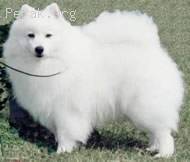
Head: Moderately wide and rounded. Distinct stop. Pointed muzzle. Small nose. Tight, preferably black lips.
Ears: Set on high, small, triangular. Held erect and turned forward.
Eyes: Moderately large, almond shape, set slightly obliquely in the skull. Dark color. Black rims.
Body: Sturdy construction. Muscular neck. Pronounced withers. Broad chest is well let down. Ribs well sprung. Belly well tucked up.
Tail: Set high, moderately long. Carried over the back.
Hair: Straight, stand-off. Short on the face, ears, and front of the legs. Long and abundant on the rest of the body. Apron on the forechest and plume on the tail. Soft, dense undercoat.
Coat: Pure white.
Size: Dog: 30 to 38 cm.Bitch: 30 to 35 cm.
Weight: Approx. 10 kg.

History

The Japanese Spitz is probably not related to the Miniature American Eskimo. Some experts think it is related to the Samoyed, but most believe the Japanese Spitz is decended from the White Giant German Spitz, which was introduced in Japan around 1920 after passing through Siberia and China. White Giant Spitz were imported from Canada, the United States, and China. In 1948, the Japanese Kennel Club published a standard for the breed. This little breed is growing in popularity in Europe.

Behavior

This sturdy, supple, lively dog is cheerful, bold, and clever. He is an affectionate pet. The Japanese Spitz is extremely wary of strangers and barks easily, making him a good “early warning” guard dog. Firm training is required.

Advice

The Japanese Spitz is well suited to life as a house dog. Regular brushing and combing is required.

Function

Pet.
Japanese_Spitz.jpg

Group
Fédération Cynologique Internationale, National Kennel Club, Continental Kennel Club, American Pet Registry Inc., American Canine Registry, American Canine Association
Native Country
Japan
Other Names
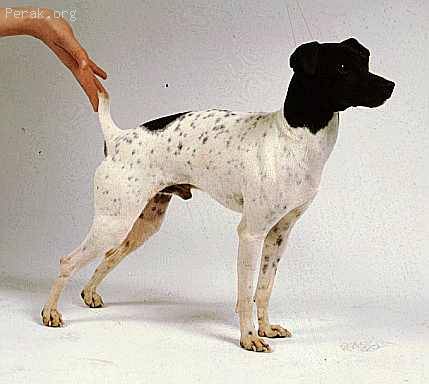
Nippon Terrier, Nihon Terrier, Nihon Teria
Breed Description

Head: Small. Flat skull. Stop not pronounced. Straight nose bridge. Tight, thin lips.
Ears: Set on high, small, thin leather, v-shaped, dropping forward.
Eyes: Medium size, oval. Dark color.
Body: Compact. Strong neck without dewlap. Chest well let down. Ribs well sprung. Strong loin. Belly well tucked up. Short, firm back. Strong, slightly sloped croup.
Tail: Moderately thin, docked to the third or fourth vertebrae.
Hair: Very short (2 mm) (0,008 in), smooth and thick.
Coat: Tri-color : tan and white with black head; white with black markings and black and tan spots on the body.
Size: Approx. 30 to 33 cm (11,8-13 in).
Weight: 3 to 4 kg (6,5-8,8 lb).

History

The Japanese Terrier was developed in the eighteenth century in the region around Kobe and Yokohama from Terriers (particularly the Smooth Fox Terrier) that had been imported from England. The Smooth Fox Terrier was crossed with local breeds, producing a breed with finer lines. Type was fixed around 1930 and the breed was recognized in Japan in 1940. The Japanese Terrier almost disappeared during World War II, and today is rare outside of Japan.

Behavior

This vigilant, lively, cheerful dog is a very affectionate pet.

Advice

The Japanese Terrier can adapt to life in the city but needs plenty of exercise. The breed does not handle cold well. Regular brushing is required.

Function

Pet.
Japanese Terrier.JPG

Group
Hound Group - American Kennel Club, United Kennel Club, Kennel Club of Great Britain, Canadian Kennel Club, Australian National Kennel Club, National Kennel Club, New Zealand Kennel Club, Continental Kennel Club, American Pet Registry Inc., American Canine Registry
Native Country
Afghanistan
Other Names
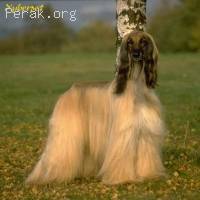
Afghan Hound, Afghan, Tazi, Balkh Hound, Barutzy Hound, Baluchi Hound.
Breed Description

Tough, hardy, and not as fast as the Greyhound, the Kabul Hound was used in his native land as a watchdog and hunter of antelope, wolf, jackal, and other game. The British Army used the Kabul Hound as a messenger dog in India.

Head: Long. Skull long, not too narrow. Prominent occipital peak. Slight stop. Long muzzle. Powerful jaws.
Ears: Set on low, carried very flat against the head, covered with long, silky hair.
Eyes: Nearly triangular, slightly slanted, preferably dark, but a golden shade is not a fault.
Body: Long. Long, strong neck. Deep chest. Well-sprung ribs. Prominent, fairly widely spaced hip bones. Flat, muscular back sloping slightly toward the hip. Straight, strong, fairly short loin.
Tail: Not too short, forming a ring at the tip, sparsely covered with hair, carried high in action.
Hair: Very long, silky, fine hair covering the forequarters, hindquarters, and entire body except the back from the withers to the base of the tail, where the hair is short and dense. Long, silky forelock starting on the forehead. Short and dense on the foreface. Ears and legs covered with long, abundant hair.
Coat: All colors are allowed.
Size: Dog: 69 to 74 cm. (27-29 in).Bitch: 62 to 69 cm. (24.5-27 in).
Weight: 25 to 30 kg (55-66 lb).

History

The Kabul Hound’s origins are practically unknown. A cousin of the Saluki (Persian Greyhound), his ancestors are thought to have been brought from Persia (Iran) to Afghanistan, where they might have developed their long coat. A favorite of Afghan royalty, Afghan Hounds were brought to England by British soldiers around 1890, after the second Afghan War. The first specimens shown in London in 1907 were a big hit. An English breed club was founded in 1926, and the breed appeared in France around 1930. Afghan Hounds were a huge fad in the 1980s.

Behavior

Calm, often dominant, sensitive, and not very demonstrative, he does not like to be bothered. Affectionate and very attached to his owner, he is distant and even haughty toward strangers. He needs firm but not harsh training.

Advice

He can adapt to apartment life as long as he has space and lots of exercise. He requires daily brushing and combing, as well as a monthly bath and grooming two or three times a year.

Function

Hunting dog. Companion dog.
Kabul Hound.jpg

Group
Fédération Cynologique Internationale, National Kennel Club, Continental Kennel Club, American Pet Registry Inc., American Canine Registry, American Canine Association
Native Country
Morocco
Other Names
Aidi, Atlas dog.
Breed Description

Head: Like that of a bear. Dry. Size in proportion to the body. Flat, broad skull. Stop not pronounced. Tapered muzzle. Black or brown nose, matching coat color. Strong jaws. Black or brown tight lips.
Ears: Medium size with rounded tips, semi-drop.
Eyes: Medium size. Dark color. Dark, slightly oblique rims.
Body: Powerful. Muscular neck without dewlap. Broad, very deep chest. Broad, muscular back. Ribs slightly sprung. Powerful, arched loin. Belly tucked up.
Tail: Long, carried down, reaching the hock joint, in the form of a scimitar at rest. Very thick fur (plume).
Hair: Very thick, slightly long (6 cm) except on the head and ears where it is very short and not as thick. Mane at the neck (particularly impressive in dogs).
Coat: Wide range of colors: white, tawny, fawn, red, black and white, fawn and white, shades of gray, tri-color, etc…
Size: 52 to 62 cm. (20.5-24.5 in).
Weight: Approx. 30 kg. (66 lb)

History

No sheepdog breed exists in the Atlas mountains. This Moroccan dog, probably originating in the Sahara, lives in the mountains and defends his owner and property from wildcats, but he has never worked as a flock guard. This explains why his 1963 standard, which was published under the name Atlas Sheepdog, was nullified in 1969. Some Kabyle Dog’s were introduced in France in 1992.

Behavior

This very rustic breed has remarkable power and agility. He is always on the alert and ready for action. He will protect his owner and loved ones from predators and strangers with great courage. This breed can even sniff out snakes. The sensitive, lively Kabyle Dog must receive firm, but kind training.

Advice

The Kabyle Dog can live indoors provided he gets exercise every day. Weekly brushing is required.

Function

Guard dog. Pet.
Aidi.jpg

Group
Fédération Cynologique Internationale, National Kennel Club, Continental Kennel Club, American Pet Registry Inc., American Canine Registry, American Canine Association
Native Country
Japan
Other Names
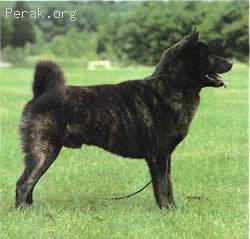
Kai Inu, Tora Inu, Tiger Dog
Breed Description

Head: Strong. Broad forehead. Abrupt stop. Straight nose bridge. Pointed muzzle. Tight lips.
Ears: Medium size, triangular. Held erect and slightly forward.
Eyes: Small, almost triangular. Dark brown color.
Body: Solidly constructed. Thick, powerful, muscular neck. Pronounced withers. Chest is well let down. Ribs moderately sprung. Belly well tucked up. Broad, muscular loin. Straight, short back.
Tail: Set high. Thick. Carried tightly curled or curved over the back in the shape of a sickle.
Hair: Short, hard, straight. Longer on the tail. Dense, soft undercoat.
Coat: Black brindle, red bridle, or brindle. Puppies are born solid color.
Size: Dog: 50 to 56 cm (19.7-22 in).Bitch: 46 to 50 cm (18-19.7 in).
Weight: Approx.: 25 kg (55 lb).

History

The Kai Dog is descended from extinct medium-size Japanese breeds and was developed in the Kai district. The Kai was used for hunting boar and deer. The breed was named as a “Natural Monument” in 1934.

Behavior

This courageous, eager, vigilant dog is always on the alert. He is also very agile.

Advice

The Kai Dog requires considerable space and exercise. Weekly brushing is necessary.

Function

Hunting dog (large game), pet.
Kai Dog.jpg

Group
Fédération Cynologique Internationale, National Kennel Club, Continental Kennel Club, American Pet Registry Inc., American Canine Registry, American Canine Association
Native Country
Finland
Other Names
Karelsk Bjornhund, Karjalankarhukoira, Karelischer Barenhund
Breed Description

Head: Triangular when viewed from the front. Broad skull. Slightly convex forehead. Distinct stop. Deep muzzle. Large nose. Thin, tightly closed lips.
Ears: Carried erect. Slightly rounded tips.
Eyes: Small. Brown color.
Body: Solid. Strong, arched neck. Capacious chest. Straight, supple back. Broad, slightly sloped croup.
Tail: Set high. Moderate length. Carried curled over the back.
Hair: Stiff and harsh. Longer on the neck, back, and back of the thighs. Soft, dense undercoat.
Coat: Black with dull brownish cast caused by the normally chestnut undercoat. White spots or markings on the head, neck, chest, underbelly, and legs.
Size: Dog: 57 cm (ideal) (22.4 in).Bitch: 52 cm (ideal) 20.5 in).
Weight: Approx. 25 kg (55.2 lb).

History

Closely related to the Laika, the Karelian Bear Dog is descended from an old Finnish breed to which Russian breeders introduced Utchak Sheepdog blood. The Karelian Bear Dog originated in Karelia, the territory extending from north of St. Petersburg to Finland. The Karelian Bear Dog was originally used to hunt elk, then later to hunt bear and large game. The breed was recognized by the FCI in 1946.

Behavior

This very rustic, hardy dog is courageous and eager. Though stable, the breed is independent and a bit anti-social. He is gentle with his family, though his personality is not like that of most pets. He uses his keen sense of smell for hunting large game. The Karelian Bear Dog is a good guard dog, but is not a herder or sled dog. Given his latent aggressive nature, this dog should never be trained to attack. Firm training is a must.

Advice

This dog must not be closed up indoors. He needs a lot of space and considerable exercise to burn off energy. Daily brushing is required.

Function

Hunting dog (large game), pet.
Karelian_Bear_Dog.jpg

Group
Fédération Cynologique Internationale, National Kennel Club, Continental Kennel Club, American Pet Registry Inc., American Canine Registry, American Canine Association
Native Country
Slovenia
Other Names
Karst Sheepdog, Istrian Sheepdog, Krasky Ovcar, Krasevec
Breed Description

Head: Broad and noble. Slightly convex skull. Stop not accentuated. Straight, broad forehead.
Ears: Lie flat against the head in a V.
Eyes: Almond-shaped eyes set slightly oblique. Chestnut or dark brown color.
Body: Strong, slightly rectangular, and well-muscled. Broad, muscular neck. The deep chest long is well let down. Straight, wide back. Wide and slightly sloped croup.
Tail: Set on high, of medium length. Saber tail. Richly clad with long hair.
Hair: Short on the head and front of legs. Long and abundant over the rest of the body. Lies flat. Mane at neck; flag tail. Feathering on the hind legs.
Coat: Iron gray, dark nuances desirable, particularly on the withers, the abdomen, and the feet. Dark mask on the head.
Size: Dog: 57 to 63 cm. (22.5-24.3 in).Bitch: 54 to 60 cm. (21.3-23.5 in).
Weight: Dog: 30 to 42 kg. (66-93 lb).Bitch: 25 to 37 kg. (55-82 lb).

History

This sheepdog lives in the mountainous region of Karst (or Kras). He is a tireless defender of the herd. This breed was mentioned for the first time in 1689 and was officially recognized in 1939 under the name of Illyrian Sheepdog, which also included the future Sarplaninac. The Karst Sheepdog and the Sarplaninac were separated in 1968.

Behavior

This dog is brave and courageous, but not aggressive. He is of excellent character and easy-going. Devoted to his owner, he makes an excellent pet. Wary of strangers and not easily won over, he is a good guard dog and will protect his owner. Firm, but not harsh training is appropriate for this breed.

Advice

This breed needs space and exercise. Regular brushing is required.

Function

Sheepdog, guard dog, pet.
Karst_Shepherd_Dog.jpg

Group
Non-Sporting Group - American Kennel Club, Continental Kennel Club, United Kennel Club, Kennel Club of Great Britain, Canadian Kennel Club, Australian National Kennel Club, National Kennel Club, New Zealand Kennel Club, American Pet Registry Inc., American Canine Registry
Native Country
Holland
Other Names
Wolfspitz, Chien Loup, German Wolfspitz
Breed Description

Head: They have a wedge shaped head, a medium-length muzzle with a definite stop.
Ears: Small pointed ears and an expressive face.
Eyes: The “spectacles,” a delicate dark line running from the outer corner of each eye toward the lower corner of each ear, which, coupled with markings forming short eyebrows, is necessary for the distinct expressive look of the breed. All markings should be clear, not muddled or broken.
Body: Sturdily built, they have a typical spitz appearance, neither coarse nor refined.
Tail: The tail is tightly curled and, in profile, should not be carried as so to be distinguished from the compact body of the dog.
Hair: The Keeshond is a color-specific spitz type; many of the names of the dog refer to the distinctive wolf color of the breed. The color is a mix of grey, black and cream. The top coat is tipped with black, while the undercoat is pale grey, white, or cream (never tawny). The color can range from very pale to very dark, but the Kees should neither be black nor white, and the ruff and “trousers” of the hind legs should be a distinctly lighter grey.
Coat: Like all spitzes, the Kees has a profuse double coat, with a thick ruff around the neck. The tail is well plumed, and feathering on the fore and hind legs add to the soft look of the breed. The coat is shown naturally, and should not be wavy, silky, or long enough to form a natural part down the back.
Size: The Kees is 17 to 18 inches (about 45 cm) tall
Weight: 35 to 40 pounds (about 16 to 18 kg).

History

The Keeshond was named after the 18th-century Dutch patriot, Cornelis (Kees) de Gyselaer, leader of the Dutch rebellion against the House of Orange. The dog became the rebels’ symbol, and when the House of Orange was returned to power, this wonderful breed almost disappeared. The word ‘keeshond’ is a compound word: ‘Kees’ is a nickname for Cornelius (de Gyselaer), and ‘hond’ is a Dutch word for dog. Fortunately, the breed continued as a guard on Dutch barges. Later, in the 1920s, Baroness van Hardenbroeck took an interest in the breed and began to build it up again. The Keeshond was accepted for AKC registration in 1930. Now bred for many generations as a companion dog, the Keeshond easily becomes a loving family member.

Behavior

An excellent children’s companion, lively, intelligent, and very alert. A real character that is quick to learn if their owners are consistent. They should be trained gently and patiently without a lot of jerking.

Advice

Will be okay in an apartment although they should at least have an average-sized yard. Keeshonden prefer cool climates; they cannot withstand the heat well due to their thick coats. Daily brushing of the long coat with a stiff bristle brush is important.

Function

Pet.
Keeshond.jpg