Group
Working Group - American Kennel Club, Doberman Pinscher Alliance of America, Continental Kennel Club, Fédération Cynologique Internationale, United Kennel Club, Kennel Club of Great Britain, Canadian Kennel Club, Australian National Kennel Club, National Kennel Club, New Zealand Kennel Club, Canadian Canine Registry, American Pet Registry Inc., American Canine Registry
Native Country
Germany
Breed Description
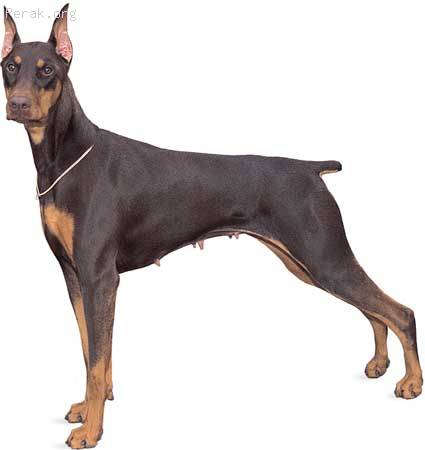
Head: Long and dry. Strong, blunt wedge-shape. Stop not pronounced. Muzzle line almost at level with topline of skull. Powerful, broad jaws. Lips smooth, lying close to the jaws.
Ears: Set on high. Cropped, erect, length in proportion to length of the head. If not cropped, semi-drop with the front edge lying alongside the cheek.
Eyes: Medium size. Oval. Dark color.
Body: Square body outline. Dry, well muscled neck. Powerful forechest. Clearly defined hocks. Well developed chest with slightly sprung ribs. Belly well tucked up. Rounded croup. Solid, short back.
Tail: Set high, short, docked after the second caudal vertebra.
Hair: Short, hard, thick, smooth, and close-lying. No undercoat.
Coat: Black or brown with clearly defined tan markings on the muzzle, cheeks, throat, forechest, legs, and feet.
Size: Dog: 68 to 72 cm. (27-28 in).Bitch: 63 to 68 cm (25-27 in).
Weight: Dog: 40 to 45 kg. (88-99 lb).Bitch: 32 to 35 kg. (70.5-77 lb).
History
This breed’s history begins in Apolda, a small German village in the province of Thueringen. F. L. Doberman developed this fearless guard dog to protect him as he made his rounds collecting taxes. Around 1870, he crossed a number of aggressive breeds (many ancestors of the Rottweiler), including local black and tan sheepdogs, the German Pinscher, the German Shepherd, the Beauceron, and the Rottweiller. The result was a vigilant working dog, farm dog, guard dog, and police dog. For hunting, the Doberman was used to fight off predators. Later, new blood was added, notably the black and tan Terrier and probably the Greyhound. In 1910, the standard for the Doberman was established. During World War I, the Doberman served as a patrol, as a sentry at military bases, and as a guide dog for soldiers blinded during the fighting.
Behavior
This is not a dog for everyone. He requires an authoritative owner who is fair, calm and will assert himself with patience and gentleness. The Doberman is blindly loyal and devoted to his owner and can be trusted with children. He is a born guardian and is extremely wary of strangers. Fundamentally peace-loving, the Doberman is an emotionally sensitive dog and does not like conflict.
Advice
This dog needs space and exercise to burn off his energy. He will not tolerate being tied up. Regular brushing is required.
Function
Working dog, police dog, army dog. guard and defense dog, pet.